Why Maitreyi Loves Attack on Titan’s Political Storytelling
Maitreyi Ramakrishnan points to Attack on Titan as political storytelling about oppression, propaganda, empathy, and moral conflict.

Direct Answer
Maitreyi Ramakrishnan points to Attack on Titan as an example of great political storytelling because it connects individual pain directly to public systems of power, state propaganda, and historical memory. Rather than delivering lectures, Hajime Isayama’s manga uses changing plot borders, military actions, and institutional fear to show how societies teach people who to hate and what to believe without question.
📺 Prefer watching over reading? You can stream full, uncut video conversations on the Books That Changed My Life YouTube Channel.
Key Takeaways
-
Politics Through Action: The story reveals its political themes through state borders, military decisions, and propaganda rather than long speeches.
-
Shifting Perspectives: Every time the map expands, earlier scenes take on a heavier moral meaning as new historical context comes to light.
-
Inherited Narratives: Questioning who benefits from an official version of history is key to avoiding real-world cycles of violence.
-
A Critical Eye at Home: Raised by union representatives and Sri Lankan Tamil genocide survivors, Ramakrishnan learned early on to question authority and analyze media critically.
About the Guest
Maitreyi Ramakrishnan is a Canadian actress best known for her breakout lead role in Netflix’s hit comedy series Never Have I Ever. Raised in Mississauga, Ontario, by parents who survived the Tamil genocide in Sri Lanka, she frequently speaks out on social justice, worker rights, and media representation.
About the Book
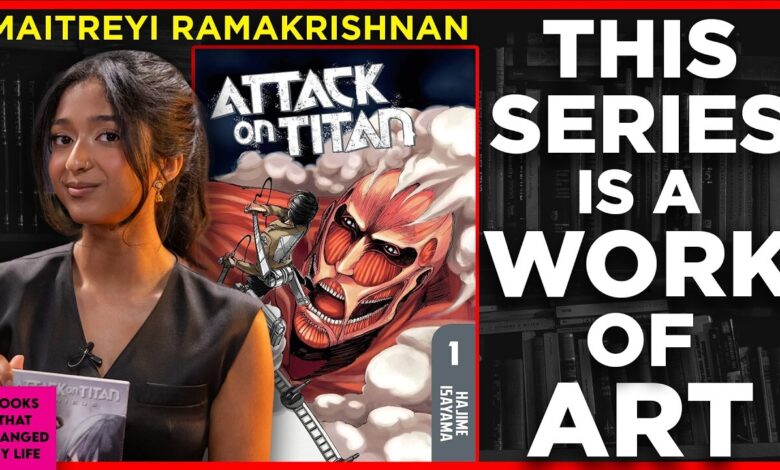
Attack on Titan (Shingeki no Kyojin), created by Hajime Isayama, begins as a survival story about humanity living behind giant walls to protect themselves from man-eating Titans. As the plot follows childhood friends Eren Jaeger, Mikasa Ackerman, and Armin Arlert beyond those borders, it completely deconstructs its original premise. What starts as a simple battle against monsters transforms into a complex story about war, ethnic discrimination, state propaganda, and generational conflict.
Political Storytelling That Never Pauses for Lectures
Ramakrishnan’s critical approach to fiction comes straight from her upbringing. Growing up in Mississauga, Ontario, her home environment revolved around active social engagement. She attended her first protest supporting Tamil genocide awareness at age five and organized student walkouts by middle school. At home, her father regularly picked apart newspaper articles, challenging her to defend her political viewpoints against tough counter-arguments.
When she picked up the Attack on Titan manga in her school library during an anime hiatus, the series felt remarkably true to real-world history:
“It is about how humanity has the constant desire to oppress, to conquer, and take over people. It is a vicious cycle that we cannot get out of.” — Maitreyi Ramakrishnan
When she was thirteen, Ramakrishnan viewed the story like most first-time viewers: as a clear fight where humanity inside the walls was good and the Titans were evil. But as Isayama revealed the world outside, those neat boundaries collapsed. She saw how every faction acted out of past trauma, government lies, and political conditioning.
Audition Lucky Charms and Real-World Lessons
Ramakrishnan’s connection to the show also has a fun personal side. In middle school, the very first clothing item she bought with her own money was an Attack on Titan sweater from Hot Topic—a sweater she still brings to acting auditions today as a lucky charm. She also felt an instant connection to Sasha Braus (“Potato Girl”) for her comic relief, love of food, and funny reluctance during military training.
For Ramakrishnan, the lasting takeaway from Attack on Titan is simple: popular stories can teach us how power actually works in the real world. Breaking destructive historical cycles starts by dismantling personal ignorance, examining our own biases, and listening to opposing viewpoints.
Structured Frameworks for Growth
If you are ready to take control of your emotional growth, navigate complex relationships, and build meaningful connections, explore structured frameworks to help you lead with clarity and authenticity. The I AM LEADER Book Set provides the structural blueprints needed to defend your personal autonomy, foster deep empathy, and unlock your true relational and leadership potential.
Explore More Discussions:
Listen to the full uncut conversation on Spotify, browse our complete archive on the main website, or find past episodes on the official podcast directory.
Frequently Asked Questions
Why does Maitreyi Ramakrishnan view Attack on Titan as political storytelling?
She considers it political because it shows how governments use propaganda, fear, and historical trauma to control populations and justify conflict.
How did her family background influence how she watched the show?
Her parents survived the Tamil genocide in Sri Lanka and worked as union representatives, so she grew up learning to analyze power structures and question official history.
What character provided comic relief for Ramakrishnan while watching the show?
She related most to Sasha Braus (“Potato Girl”) because of her humor, huge appetite, and lack of athletic drive during military drills.
Summary
Attack on Titan endures because it refuses to offer easy answers or clean moral high grounds. By showing how personal choices tie directly to political history, the series reminds us that empathy and critical thinking are essential tools for breaking inherited cycles of conflict.